
Meet The Villagers Who Help Your Player Level Up: Understanding Related Services

Updated: 5 days ago
Part of the “Understanding the IEP” Series

If accommodations are the tools,
and modifications are the mission size,
and SDI is the guide who teaches the craft,
Then Related Services are the villagers — the specialists with unique professions who help your player access what they need to move, communicate, regulate, and participate in the world.
They don’t change the mission.
They don’t change the tools.
They don’t change the teaching.
They provide the specialized support that makes all of that possible.
Yet, this part of the IEP often feels confusing. It can sound like two villagers conversing in 'hrmm's', 'huh huh's,' and 'hmmmm' without offering subtitles. So, let’s translate it into something that makes sense.
🎮 What Are Related Services?
Related Services are specialized supports that help a student access learning by strengthening the skills that sit underneath academics.
They’re not “extras.”
They’re not “bonus features.”
They’re not “only if there’s time.”
They’re the villagers — the OT, PT, Speech, and Counseling professionals who each have a unique “profession” and offer specialized help your player can’t get from general teaching alone.
Just like:
the Toolsmith helps you craft and use tools effectively
the Fletcher helps you move safely and navigate terrain
the Librarian helps you communicate and learn new words
the Cleric helps you regulate and restore balance
the Cartographer helps you plan and adapt your learning path
Related Services help your child build the foundational abilities that make learning possible. They don’t replace teaching. They support the player so teaching can work.
🧱 The Big Villagers
Here’s what each “profession” actually does — in parent language, not edu‑jargon.
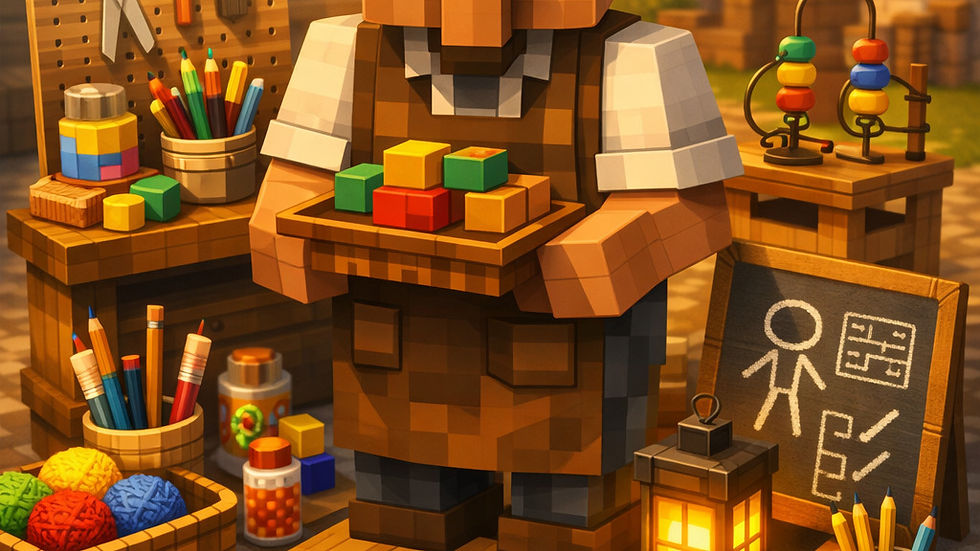
🧤 Occupational Therapy (OT): The Fine‑Motor & Sensory Villager
OT is the villager who helps your player use their hands, tools, and materials effectively so they can actually participate in the world.
In Minecraft terms, OT is the Crafting/Toolsmith villager — the one who supports all the hands‑on parts of gameplay:
organizing inventory
manipulating small items
crafting with precision
managing sensory input
staying regulated enough to keep playing
participating in routines and tasks
OT isn’t about “fixing handwriting.” It’s about helping your player build the motor, sensory, and functional skills that make learning possible — the same way a Toolsmith helps you get the right tools and use them well.
This villager supports the player’s ability to do things: hold, cut, build, craft, organize, focus, and participate.

🦵 Physical Therapy (PT): The Movement & Mobility Villager
PT is the villager who helps your player move their body safely, efficiently, and confidently through the world.
In Minecraft terms, PT is the Fletcher villager — the one who supports all the movement‑based parts of gameplay:
balancing on uneven terrain
climbing ladders and stairs
navigating long distances
building strength and endurance
coordinating big body movements
accessing playgrounds, hallways, and school routines
PT isn’t about “making kids athletic.” It’s about helping your player build the gross‑motor and postural skills that make participation possible — the same way a Fletcher helps you aim, move, and navigate the landscape.
This villager supports the player’s ability to move through their world with stability, safety, and confidence.

🗣️ Speech‑Language Therapy (SLP): The Communication Villager
Speech is the villager who helps your player understand, use, and navigate language so they can connect with others and access learning.
In Minecraft terms, Speech is the Librarian villager — the one who supports all the communication‑based parts of gameplay:
finding the right words
understanding directions
expressing needs and ideas
building social communication
strengthening articulation
learning new vocabulary and concepts
Speech isn’t about “fixing talking.” It’s about helping your player build the language, communication, and social‑connection skills that make learning possible — the same way a Librarian helps you access the right words, books, and knowledge.
This villager supports the player’s ability to communicate clearly, confidently, and meaningfully.

🔮 Behavior Analyst (BCBA): The Regulation and Skill Building Villager
Behavior is the villager who helps your player understand expectations, build new skills, and regulate their behavior through structure and support.
In Minecraft terms, Behavior is the Cleric villager — the one who supports all the regulation‑based parts of gameplay:
understanding routines
accessing reinforcement
learning replacement behaviors
navigating transitions
building independence
staying regulated enough to participate
Behavior isn’t about “fixing behavior.” It’s about helping your player build the predictability, routines, and skill sets that make participation possible — the same way a Cleric uses potions and structure to restore balance and support growth.
This villager supports the player’s ability to self‑regulate, adapt, and engage.

❤️ School Counseling / Social‑Emotional Learning (SEL): The Emotional-Skills Villager
Counseling is the villager who helps your player understand their feelings, cope with challenges, and build healthy relationships.
In Minecraft terms, Counseling is the Shepherd villager — the one who supports all the emotional‑well‑being parts of gameplay:
naming emotions
practicing coping strategies
navigating conflict
building self‑awareness
strengthening self‑advocacy
developing resilience
Counseling isn’t about “fixing emotions.” It’s about helping your player build the emotional and social skills that make learning possible — the same way a Shepherd weaves patterns, creates calm, and nurtures the flock.
This villager supports the player’s ability to feel, cope, connect, and thrive.
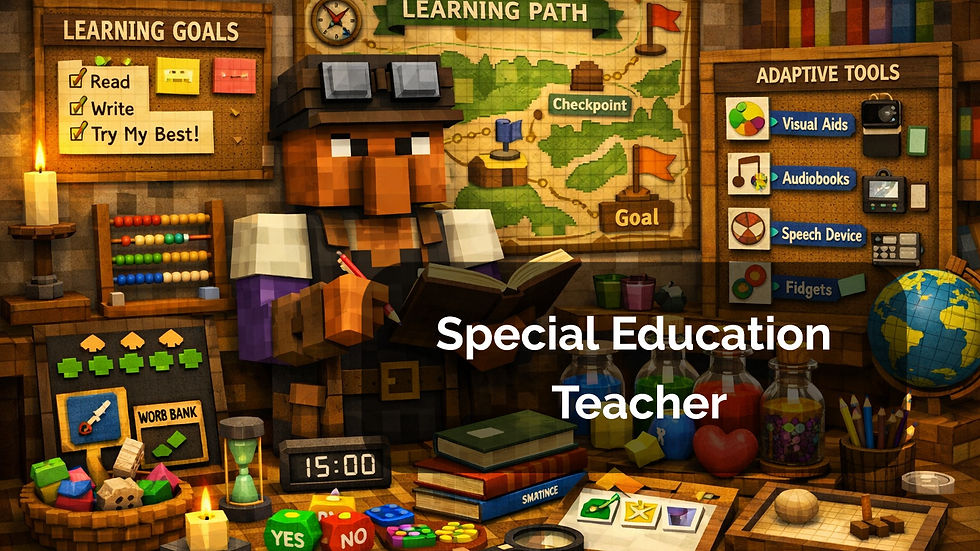
📜 Special Education Teacher: The Learning Path Villager
Special Education is the villager who helps your player navigate the curriculum through individualized paths, supports, and strategies.
In Minecraft terms, Special Education is the Cartographer villager — the one who supports all the planning‑and‑mapping parts of gameplay:
breaking down complex tasks
adapting materials
providing accommodations
teaching strategies explicitly
monitoring progress
guiding individualized learning routes
Special Education isn’t about “watering down work.” It’s about helping your player build the accessible learning pathways that make education possible — the same way a Cartographer maps routes, marks obstacles, and charts the safest path forward.
This villager supports the player’s ability to learn, navigate, and succeed on their own map.
🧭 How Related Services Fit Into the IEP
Related Services are added when a student needs specialized support to access learning — not because a diagnosis says so, not because it’s “nice to have,” and not because someone “thinks it might help.”
They’re included when:
a foundational skill affects learning or participation
the student needs direct support from a specialist
the service connects directly to IEP goals
the support helps the student access the curriculum
They’re not random add‑ons. They’re targeted, purposeful, and tied to the student’s needs.
🧠 Related Services vs. SDI vs. Accommodations (Quick Parent Guide)
Accommodations = tools
Modifications = mission size
SDI = the guide who teaches the craft
Related Services = the villagers who provide specialized support
Each part of the IEP has a clear role — and villagers finally give Related Services a metaphor that fits.
❤️ Parents, Here’s the Heart of It
Related Services aren’t about “fixing” your child. They’re about supporting the skills that make learning possible. They say:
“Your child deserves access.”
“Your child deserves support.”
“Your child deserves specialists who understand their needs.”
“Your child deserves a team that builds skills, not barriers.”
Just like in Minecraft, when players get the right villagers in their world, they:
explore more
try new things
take on bigger missions
communicate more clearly
move more confidently
regulate more effectively
Not because they were “fixed,” but because someone provided the specialized support they needed to grow.
🧱 The Big Takeaway
Related Services are the villagers of the IEP — the specialists with unique professions who help students build the foundational abilities needed to learn, communicate, move, and participate.
They don’t change the mission.
They don’t change the tools.
They don’t change the teaching.
They support the player — so they can take on the mission with confidence.


Comments